|
| Hardware Parts Accessories |
|---|
| Electronics |
| Guitar Wood and Kits |
| Tools |
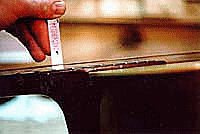
One of the most challenging repairs is the acoustic guitar neck reset. A neck reset is an invasive job which requires both skill and guts to execute correctly. To be able to do a clean neck reset is an accomplishment to be proud of. A misstep can destroy an instrument. I liken resets to heart surgery, the patient is usually in distress, non-functional. If the operation is a success the patient will have a new fulfilling life, but the patient could also die. Well, in most cases a guitar cannot be killed from a neck reset gone awry, but neck heels do break off, soundboards and sides can crack, and finishes can be damaged. But a well trained, careful repairman accepts and enjoys the challenge. In the following article I will be discussing a number of aspects related to the removal of a neck from a CF Martin guitar, but most of the elements also apply to resetting the neck of any guitar with a glued neck joint. The need for a neck reset is indicated by high string action, and no means to adjust out of it, i.e. the saddle is as low as it can go. For most players this will mean that, the height of the low E string, as measured from the top of the 12th fret to the bottom of the E string,is 4/32" or greater, with the saddle set as low as it can go. On necks that have adjustment rods, the neck is showing little or no relief. In essence, the relationship between the neck and the body is out of wack. In most cases the neck is not pulling up so much as the top of the guitar, in the area of the bridge has pulled up over time.
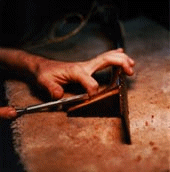
Once sure that the only way to regain good playing action is to perform a neck reset, the first step is to seperate the fretboard extension over the body. A heat lamp, heat strip or other heat generating device is generally used to warm the glue joint between the fretboard and the top. It is a good idea to cover the top with a heat reflecting material. In photo 2 I use a material that firemen's suits are made from.
Once the joint begins to separate I sometimes slide thin wedges of wood in to keep the joint open, mindful not to put too much pressure on the fretboard which could crack. Additionally, care must be taken not to overheat the instrument.When working with the thin knifes it is all too easy to damage the finish as well as the wood of the top in the area of the fingerboard during this operation. Additionally, other glue joints can be weakened by the heat. 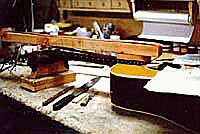
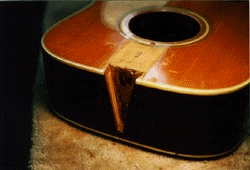
If your karma is good (and also your customers) after a few minutes the fretboard is separated from the soundhole up to the 15th fret (assuming 14 to the body joint). The next step is to remove the 15th fret and drill a hole in the slot. On most Martin guitars you will now have access to a small gap between the back of the dovetail and the pocket of the neck block. On other guitars, who knows? The idea now is to loosen the glue in the neck joint and then slide the neck off. Warm moist air generated by a pressure cooker is the method I use to loosen the glue. My good friend and mentor Mark Glickman used a stove top espresso maker. In my shop the pressure cooker sits atop a hot plate. A flexible hose is attached, at the end of which a reducing valve with a hollow pin (I use an inflation needle) is mounted. Once the cooker is heated and shooting steam out the needle, the needle is inserted into the hole you have drilled in the 15th fret slot. Just how much steam and how long the needle is left in the guitar is variable. Too much moisture in the neck joint for too long will expand the wood and lock the neck in. Too much steam can destroy the finish of the neck or the guitar body. Too little and the glue will not soften. Each case is different, but only as much exposure to the heat and moisture as is necessary is the ideal.
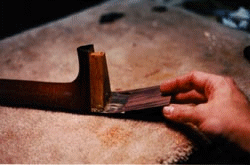
In most cases the neck is not falling off prior to the neck set and is tightly seated in the dovetail joint. The neck will have to be pushed off ever so gently, but firmly, once the glue is softened.In most cases, I find that I can slowly work the steam softened neck joint loose and then slide the neck off by hand. But sometimes a very tightly fitted neck will have to be pushed off with the use of jig designed specifically for the this purpose. There are two common styles of neck removal jigs. One is essentially a rack which mounts to the body, the other is a larger bench-top jig. In both cases a screw press the neck off while holding the body in place. 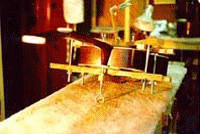 When using one of the jigs, the guitar is mounted into the jig after the steam has begun to loosen the joint. Pressure is applied to the heel by the screw mounted on the jig. If everything goes right the neck slides off. Sometimes the neck POPS! off, so you have to be ready to catch it. If things aren't going well, the neck doesn't budge.But in most cases, with with persistence and a bit of finesse, the neck can be worked off the body. With the neck off, most of the old glue can be cleaned up before it dries. The body and neck are left for at least a day to dry.
Neck resetting is very challenging. Only a repairman who has seen it done many times should ever try it on a guitar he does not own. And even then, think long and hard before you do. |
 The first step
is to evaluate the guitar
and make sure there aren't any other issues contributing to the problem.
A loose top brace could allow the top to lift, causing high action, but
when reglued could bring the action back down. Similarly, a loose bridge can cause high action.
The first step
is to evaluate the guitar
and make sure there aren't any other issues contributing to the problem.
A loose top brace could allow the top to lift, causing high action, but
when reglued could bring the action back down. Similarly, a loose bridge can cause high action.
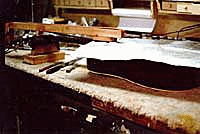 On guitars made with white glue,
the heat turns the glue to gel rather
quickly and it is easy to then slide a thin palate knife into the joint to
separate the fretboard. On guitars made with hide glue the job can be much trickier.
Hide glue is very strong, and dries very crystalline and brittle. Sometimes a thin tool
can slide into a hide glue bond and break right through. But heat
alone does not soften hide glue so a bit of water must be introduced if the desire is to soften it.
When necessary, I use a small amount of warm water on the palate knife to soften the glue and enable me to carefully
seperate the joint.
On guitars made with white glue,
the heat turns the glue to gel rather
quickly and it is easy to then slide a thin palate knife into the joint to
separate the fretboard. On guitars made with hide glue the job can be much trickier.
Hide glue is very strong, and dries very crystalline and brittle. Sometimes a thin tool
can slide into a hide glue bond and break right through. But heat
alone does not soften hide glue so a bit of water must be introduced if the desire is to soften it.
When necessary, I use a small amount of warm water on the palate knife to soften the glue and enable me to carefully
seperate the joint.
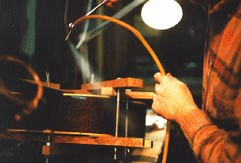
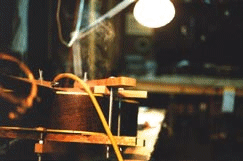
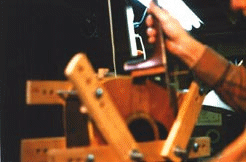
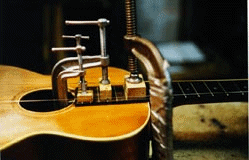 Finally the joint
is glued and clamped. If all has gone well the
guitar can be strung up and played the next day. Judging how much wood to remove is part science
, part experience . I never reset a neck without a proper bridge in place on the top. The correct
angle is determined by the bridge height plus the desired saddle height above the bridge, plus,
an estimate of how much the top will lift under tension. This is very important, and very tricky to
determine.
Finally the joint
is glued and clamped. If all has gone well the
guitar can be strung up and played the next day. Judging how much wood to remove is part science
, part experience . I never reset a neck without a proper bridge in place on the top. The correct
angle is determined by the bridge height plus the desired saddle height above the bridge, plus,
an estimate of how much the top will lift under tension. This is very important, and very tricky to
determine.